
So, you are a female, 50 years old or older, and you are dealing with hair loss. You may have tried a bunch of things, or maybe you’ve just begun the journey, and you want to know what to do and how to do it.
Hi, my name is William Gnet. I’m the CEO and founder of Evolution Hair Loss Institute in Advanced Triology Products. And today, I’m going to answer that question — because women who are 50 years old and older are dealing with a different set of circumstances than, say, a younger female in their early 20s or even in their early 30s.
And as time goes on, and as you are 50 and older, you are most likely dealing with menopause at this point, or at least very clearly perimenopause — when your ecosystem has changed, and you went from the highest level of estrogen at about age 35, to now, where you’re at at 50, possibly at a place where you are making very little to no estrogen at all.
Why is my hair falling out in a 50 year old female?
Then, that is going to change the way that your body is interacting with your hormones, with your gut, with your nutrient levels — and that has to be managed. And there is no one-size-fits-all product. There has to be some level of customization to your particular situation.
And in a perfect world, you’d go ahead and take the hair pull test, you’d go ahead and get some blood work. But if you can’t do that, this is a phenomenal place to start — because realistically, it’s going to cover the vast majority of the bases.
And I’ve have seen so many women in this particular age bracket — because hair loss is a very prominent thing when you’re going through perimenopause, and menopause, and postmenopause.
And when you’re dealing with this particular set of circumstances, there often times is very terrible advice when you are going to your physician — not to say that, you know, physicians are going to give bad advice — but most of the time, unless you understand exactly what’s going on, it is very, very difficult to pinpoint exactly what you need to manage your particular situation.
And there are all sorts of other things that you may be using to manage menopause — whether it be hormone replacement, or realistically, there could be, you know, dietary components, there could be other medications that you’re on at this point — whether that be for cholesterol, or blood pressure, or anti-anxiety — that all play a role in how you have to manage this situation.
I’m going to talk about some of these items on how to go through them today — kind of the dos and don’ts. And obviously, we are here to support you to get your best growth possible. And this is a really good blanket protocol for this age bracket.
But if you need customization — take the hair pull test, go get the blood work, and we will help manage it in a more granular situation in that scenario.
But as an overall streamlined process — let’s talk about this.
So, going through perimenopause — if you are on hormone replacement, you must think about what type of hormones you’re on. If you’re on progesterone or estrogen, that’s fine — you know, obviously deal with that with your prescribing physician.
If you are on testosterone, you probably are seeing an accelerated shedding, and you need to most likely reduce or eliminate that testosterone — because it is going to accelerate female pattern loss on the top of the head.
If you are dealing with that, you potentially losing hair from all over the scalp — but if you’re dealing more with a DHT-related loss, that’s on the top of the scalp — and an inflammatory and nutritional loss is kind of throughout the entire scalp, but often times more isolated to the back and to the sides.
So, when you’re looking at that, make sure that you’re looking at the entire process of what you are dealing with.
And if it’s hormone replacement — if you’re on testosterone, you should minimize that or reduce it.
Why is my hair thinning around my face female?
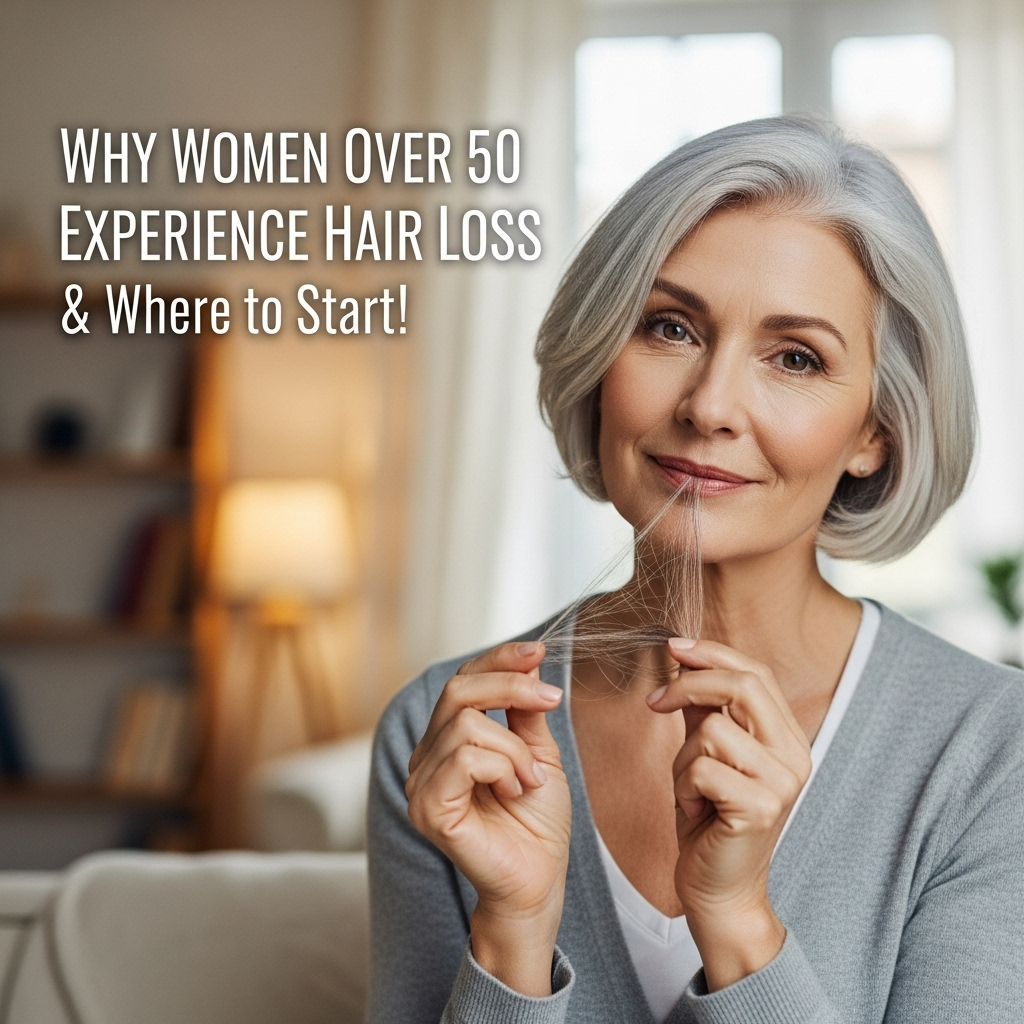
If you are on any other medications, I want you to think about — did you start losing hair 6 months after, or up to 3 months after, you began using those medications? If you did, there could be a medication component that you need to either reduce or switch out. So, that’s another item to consider.
And, you know — are you on any type of dietary restrictions that may be reducing your iron? Are you menstruating at a very irregular basis because you have not gone full menopause yet? And if that’s the case, you were just losing a tremendous amount of blood — then you need to be looking at ferritin.
This is going to help streamline a lot of this — but if you have very specific needs, then you’re going to again need to get that blood work.
I’m going to talk about — with the hundreds, if not thousands, of clients in this particular age bracket — and exactly what I’ve recommended for them. For the most part, that is going to be wrapped into this — and then kind of a next level to this.
First and foremost, quite frankly, I always recommend vitamin D — if you are deficient. But probably in this age bracket, I’ve seen more women conscious of vitamin D than probably any other type of person.
If you are on vitamin D3, and your blood levels are at least 60 ng per milliliter — disregard this. But if you’ve never taken vitamin D, you should be taking 5,000 units a day for the next 6 months — just to kind of get you up to probably a neutral level.
So, vitamin D3 is a hormone. It is going to allow your liver to process hormones more efficiently. Additionally, it is going to reduce DHT a little bit — because if you are low, you end up actually producing a little bit more DHT than you should, and a little bit less testosterone — so that kind of balances this out a little bit.
So, if you are on vitamin D already, then don’t worry about this — or if your vitamin D3 levels are already at 60 ng per milliliter or higher.
So, that is vitamin D.
The most important portion of this is the DHT blocking in this section — because when your estrogen decreases, you are losing the DHT protection that you once had. You have a high level of estrogen, and that level of estrogen at age 35 is going to protect you against DHT.
But as that estrogen is slowly declined, now all of a sudden, your DHT levels are relatively the same, but you have far less estrogen — so now those DHT molecules are going to bind to the DHT receptors where they couldn’t before — and that is going to cause more loss on the top of the scalp.
So, the DHT blocker is going to allow you to reduce the impact of that DHT. This is going to last one month — you take two in the morning, two at night, with food — and that is something that is going to help reduce the influence of DHT on the hair follicles. Very important in this particular scenario.
I’m going to actually jump right into the EFA Complete in this one.
So, balancing these hormones — balancing the way that the menopause or postmenopause is influencing your body — or perimenopause — you are going to use the EFA Complete, which is going to have evening primrose oil, borage oil, flax oil, and fish oil — to help reduce inflammation, but also help balance the hormones.
Evening primrose oil is a phenomenal hormone balancer. This is one of the few that’s out there that’s enteric coated — and it’s going to actually pass through your stomach and release in the small intestine, which is where you’re going to absorb the most of it.
This is also one month — you’re going to take two in the morning, one at night, with food — and that is one of those items that is going to really be powerful in this scenario — so that you can get the best results for your hair as possible.
The next is the F Growth Vitamin. Most of the time, you’ve probably heard of biotin, you’ve probably heard of B complex, you’ve probably heard of thyroid support. This does all of that — because you, at this age, may not be absorbing nutrients as well as you should — and that is common for a lot of different age brackets.
But in this particular circumstance, when your hormones change, it changes your gut microbiota — and when your gut is changing, it is going to potentially decrease the amount of nutrients you’re absorbing.
Also, if you’re on a calorie-restricted diet — if you are on basically a restricted diet in any way — whether that be from meat, whether that be from, you know, other aspects of really trying to contain sometimes weight gain associated with menopause — then you are probably going to be nutritionally deficient in some category.
This is also going to support ability for your body to handle stress more effectively. It’s going to support your thyroid. It is going to support basically your entire system — really have the best overall nutritional values to support your hair growth in its most complete way.
So, now you’ve covered all of your bases nutritionally with these three items. And again, this is also going to last 1 month — and so you’re going to use one in the morning, two at night, with food.
The final aspect of this — to round out a very, very solid, complete nutritional program — but also for your hair — it is going to allow for such a complete overall protection in all aspects for your hair.
You’re going to use the topical, which is called the F Growth Serum. This has so many different things — including topical vitamin D, including a tincture of black hawash, which is going to help support minimizing peripost menopause on your scalp — but it is also going to encourage a decrease of inflammation with rosemary, lavender, thyme, and other essential oils — as well as handle any microbials that may be on the surface of the scalp — including fungus, bacteria, and yeast — that is potentially going to accelerate shedding, also cause itching, burning, and other scalp irritation.
So, this could be used as much as twice a day in some cases. In this genre, I would have people start out at about twice daily applications for the first 30 to 90 days — but at least once a day topical. Get the entire scalp if needed — if you’re losing from the entire scalp — and that is going to be a huge, huge benefit to this entire situation.
When you’re utilizing all of these together, this is a phenomenal place to start.
If you have visible loss — if you’ve got areas that are really thin through the top portion of the scalp — I would also recommend adding the laser.
The laser is an 80 diode device. I’m going to recommend that you start out at 10 minutes, twice weekly. Do not ever exceed 80 diodes in this particular circumstance — because it is simply too much. If you’re already on a high level of laser, I need you to reduce that. That is something that you should really contact us for.
It is one of those things that you need to give yourself just enough energy to support the hair regrowth — to support the utilization of all of these items that you’re now giving to your body — so that you can get the best results possible.
So, 10 minutes, twice a week to start — typically like a Monday/Thursday, or Tuesday/Friday.
Then, after that first 90 days, you can bump up to 15 minutes, twice weekly. And then another 90 days after that, you can bump up to 20 minutes, twice weekly — and just stay there.
You’re typically going to maximize the value of your treatment after about 18 to 24 months — where you will have potentially regrown as much hair as conceivably possible.
Throughout the duration of this, we can typically only go back in time 3 to 5 years as far as the overall value of regrowth — but there are so many other things that you can do after this — whereas you can add, conceivably, minoxidil, you can add PRP — and those things are going to help enhance this even further.
So, I hope that really gives you some clarity on exactly what you should be taking as a female, 50 years old or older.