
Hello, everyone. Welcome back to SG Dr Wellness. My name is Dr Chen Yiming, I’ll be talking about alopecia areata. It is a unique type of hair loss with a very characteristic appearance.
What exactly is alopecia areata? How is it diagnosed? Who are at risk of getting it, and how can it be treated? Watch till the end to learn more about it. And if you are new to my channel, click on the subscribe and notification button now.
I have previously talked about male pattern hair loss in my other video, and if you’re interested in watching that video, click on the top right of your screen now.
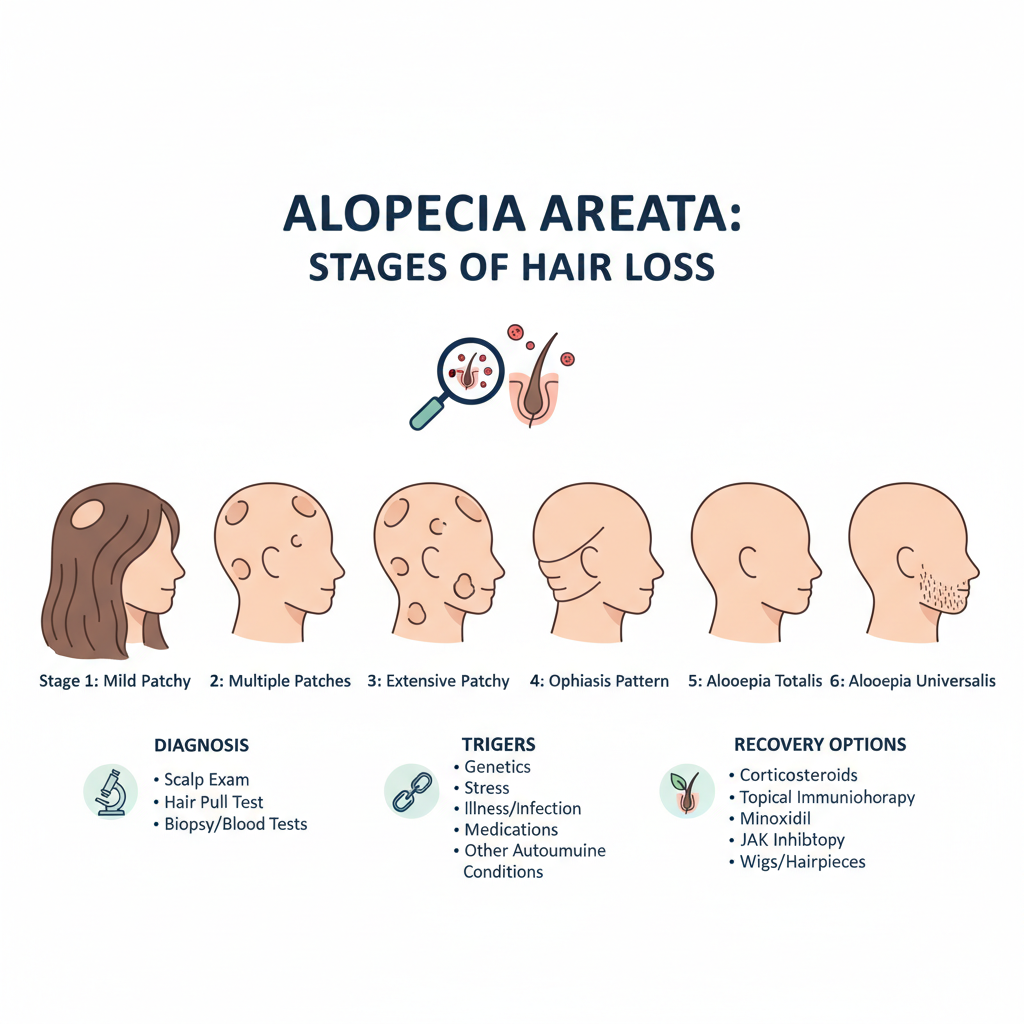
This is alopecia areata. These are all the pictures showing different forms and extent of alopecia areata. It is otherwise known as autoimmune alopecia. The body of these patients produce immune cells that actually causes destruction of hair follicles. The exact mechanism is not yet fully understood.
Clinically, the bald patch will look pinkish and smooth, with very fine thin hair surrounding it. And if you examine the fine hair surrounding the patch of hair loss with a dermatoscope or magnifier, you may see exclamation mark hair, where the thinning of the stalk of the hair is near to the follicle.
This hair loss disease may affect any part of our body with hair. The most common areas include the scalp and eyebrow. Most cases are mild, where you see only less than five spots on the scalp. However, in severe cases, you may have alopecia totalis, where nearly all the hair on the scalp is lost, and this is seen in about 5% of all cases, or alopecia universalis, where all the hair on the entire body is lost. Fortunately, this occurs in less than 1% of the cases.
Occasionally, it can involve the nails as well. Some patients may exhibit pitting, ridging, or separation of nail from the nail bed, known as onycholysis. The diagnosis of alopecia areata is usually a clinical one, made by the doctor’s examination.
What are the risk factors of getting alopecia areata? Technically, it can happen to anyone or everyone, with a lifetime risk of about 1% to 2%. However, your chance of getting it is higher if there is a positive family history. About 10% to 20% of patients have a family history of alopecia areata.
Two, if you have other autoimmune diseases like Coeliac disease, thyroid disorders, vitiligo, or rheumatoid arthritis. Three, if you have allergic conditions like atopic eczema or allergic rhinitis. We do know also that there are triggering factors that can provoke the onset of hair loss, like emotional or physical stress, hormonal changes, trauma, and viral infections.
Is alopecia areata treatable? Definitely. The milder cases of alopecia areata tend to recover on their own. It may take months to years before the hair on the bald patch gradually grows back again.
There are some ways to accelerate the hair regrowth. Options include topical minoxidil, like minoxidil spray. Steroid treatment, either injection into the bald patch or topical application of steroid lotions. And in severe cases like alopecia totalis, application of immunotherapeutic agents on the affected area may be helpful. Systemic treatment with oral or intravenous medications may be reserved only for patients with rapid and chronic hair loss that involves large areas of the body. Oral steroids or even oral biologics have been explored.
However, recurrence rate of alopecia areata is pretty high, as high as 50%. In some cases, the hair loss may be permanent. Avoidance of stress may be helpful in reducing the recurrences. Click on the top right of the screen now to access my video on the top ten ways to maintain a healthy mind to reduce your stress.
When all else fails, artificial hair such as wigs or hairpieces can be used to provide coverage for the scalp. Artificial eyelashes or eyebrows, or innovative cosmetics and tattoo, can be used to improve the appearance.
So there you go. I hope you have learnt more about this type of hair loss. Understand that it is autoimmune in origin, and it can be recurrent. Seek treatment early if you see this happening to you or your loved one. Share this video if you find it helpful. Subscribe to my channel to be updated whenever a new video is released every week. So, till the next time, stay safe and stay healthy.